
Automotive SW Development Competitiveness
Based on CMMI Level 3
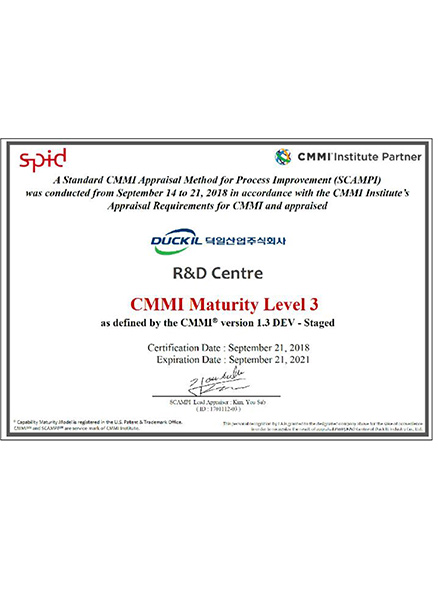
In September 2018, Duck-il Industry officially acquired the CMMI Maturity Level 3 certification from the Software Engineering Institute (SEI) at Carnegie Mellon University in the US. Based on this, we ensure perfect consistency and traceability of the automotive software development lifecycle, in addition to controlling automotive system hardware.
We constantly run advanced V-Model-based organizational capabilities corresponding to Automotive SPICE Level 2 / 3, which is a core automotive electronic standard required by German and global OEMs.
Duck-il V-Model Development Process
We maintain strict traceability links from requirement elicitation to lower architecture coding and integration testing.
System & Software Design (Engineering)
System Requirement Analysis & Architecture Design
Reviewing customer requirements to define system functions and design HW/SW split allocation architecture
Software Requirements & Architecture
Software function allocation and interface definition per module for controller internal MCU and sensor feedback
Software Detailed Design & Coding
Implementing detailed module algorithms and compiling source code according to automotive coding standards (MISRA C, etc.)
Integration Verification & Testing (Verification)
System Integration Verification & Vehicle Testing
Verifying function operations of the overall electronic assembly and checking compliance with customer specs in combination with module hardware
SW Integration & Software Testing
Screening for integration logic conflicts after module coupling and testing software requirement compliance
Software Unit Verification
Proving function-unit integrity through static/dynamic code analysis tools